Weekend Getaways From Austin: An Honest, Crowd-Aware Guide for Right Now
Table of Contents
- The Problem With Every ‘Best Weekend Getaways From Austin’ Article You’ve Already Read
- Under 90 Minutes: The Destinations Still Holding Their Ground (And the One That Isn’t)
- The 90, 120 Minute Band: Where the Drive Starts to Pay What It Costs
- The Frio River / Concan Area: The 2-Hour Question Sofia Can Actually Answer Right Now
- Destinations Sofia Is Actively Steering You Away From Right Now
- The Timing Grid: When Each Destination Is Actually Worth It vs. When to Stay Home
- Before You Book: The Logistics Reality Check Every Austin Weekend Deserves
The Problem With Every ‘Best Weekend Getaways From Austin’ Article You’ve Already Read
I pulled off the county road on a Thursday morning in May, the kind of morning where the light hits the water before the heat hits you. I’d been coming to this swimming hole for years. No sign marks the turnoff. You have to know where the fence line dips. I’d never written about it, never posted it, never even texted the pin to anyone outside my immediate circle. But when I walked down the slope, I counted more cars than I’d ever seen there. Austin FC stickers. Stanley cups sweating on limestone. Someone’s Bluetooth speaker pushing a playlist I recognized from my own Discover Weekly. I stood there for a full minute, then got back in my car. I’m not naming the spot. That’s the point.
That moment crystallized something I’d been feeling for a while: the standard weekend getaways from Austin article is not a guide. It’s a listicle wearing a guide’s clothes. The format is always the same. Fifteen destinations, each with a paragraph that could have been written in 2019 (and probably was), no mention of whether the writer visited last month or last decade, no acknowledgment that a place can be great in theory and miserable in practice because everyone read the same list you’re reading now.
So here’s what this guide does differently, stated plainly so you can hold me to it. First: my recency rule. Every destination in this piece includes when I last visited. If that visit happened more than 12 months ago, I flag it clearly. No quiet recycling of old impressions dressed up as current advice. The Texas landscape changes, new restaurants open and close, visitor numbers shift year over year, and a recommendation that doesn’t account for that is just nostalgia with a hyperlink.
Second: every destination carries what I’m calling a Verdict Card. You’ll see the same five fields repeated throughout: Drive Time (realistic Friday PM), Budget Tier, Booking Lead Time, Current Crowding Status, and Sofia’s Current Verdict. The format exists because vague enthusiasm is useless. You need to know whether a place requires reservations three weeks out or whether you can leave Friday after work and figure it out on arrival.
Third, and this is the part that makes everything else credible: some destinations in this guide receive an “Avoid” crowding status and a definitive steer-away verdict. I will redirect you away from places. If a town’s infrastructure can’t handle its current visitor volume, if a once-quiet park now has a 90-minute entry line on Saturdays, if the experience has degraded enough that the drive isn’t justified, I’ll say so. A guide that recommends everything recommends nothing. The positive verdicts only mean something because the negative ones exist right beside them.
That swimming hole I didn’t name? Consider it exhibit A. The best weekend getaways from Austin aren’t the ones everyone already knows about. They’re the ones someone with recent, specific, honest information can help you find, time correctly, and actually enjoy. That’s the contract.
Under 90 Minutes: The Destinations Still Holding Their Ground (And the One That Isn’t)
The sub-90-minute band is where demand is fiercest, where Instagram has done the most damage, and where the gap between expectation and reality yawns widest. Three destinations dominate this tier. Two of them still earn the drive. One has crossed a line.
Wimberley
Realistic Friday drive time: 75 minutes from downtown Austin, assuming you leave by 3 PM. Leave at 5 PM and you’re looking at closer to two hours, because RR 12 south of Dripping Springs becomes a single lane of brake lights once the weekend migration starts.
The honest take: Wimberley on a Saturday in October is indistinguishable from South Congress with a creek. Market Day, held the first Saturday of each month from March through December, draws visitors into a town built for a fraction of that volume. The square fills by 9 AM. Parking becomes a competitive sport. The boutiques and food trucks cater almost exclusively to day trippers now, and the vibe reads less “Hill Country escape” and more “outdoor mall with better scenery.”
That said, Wimberley during the week, or on a non-Market Day weekend in January or February, is a different place entirely. Blue Hole Regional Park operates a timed entry reservation system during peak season, and the window that matters is the first slot of the day. If you’re not booked into that early morning entry, your odds of a calm, uncrowded swim drop sharply. By midday on any summer Saturday, the park hits capacity and turns people away. The reservation system works, but only if you treat it like a concert ticket: set a reminder, book the moment slots open, and plan your entire day around that anchor.
Has Wimberley retained anything authentic post-2021? Fragments. The Wimberley Valley Winery still feels locally rooted. A few of the older restaurants along the creek haven’t rebranded for the Austin overflow crowd. But the honest answer is that the town’s identity has shifted. It’s a day trip destination now, not a retreat. If you go, go Tuesday through Thursday, skip the summer entirely, and target the dead months of January and February when the creek is cold and the crowds are gone. This assessment matters even more by the time you reach the “Destinations Sofia Is Actively Steering You Away From” section below; the trajectory since 2021 has not reversed.
Bastrop and Lost Pines
Realistic Friday drive time: 50 minutes heading east on Highway 71, and traffic is lighter than any westbound Hill Country route because you’re driving against the current. Almost nobody leaving Austin on a Friday afternoon is heading east. That alone is a meaningful advantage.
The honest take: Bastrop gets overlooked because it doesn’t photograph as well as the Hill Country. The landscape is pine forest, not limestone bluffs and turquoise water. It doesn’t pop on a phone screen the same way. This is precisely why it still works as a weekend getaway from Austin.
Bastrop State Park has made a remarkable recovery from the 2011 wildfire that burned over 96% of the park. The Lost Pines forest is regenerating visibly, with young loblolly pines now tall enough to create genuine canopy shade on many of the trails. You can book the park’s cabin loop without the frantic reservation scramble that Garner or Pedernales demand. The hiking is moderate, the river access is easy, and the town of Bastrop itself has a growing food scene anchored by actual residents, not weekend tourists.
Marble Falls and Inks Lake: The Skip
Realistic Friday drive time: 80 minutes, but that number is deceptive. The Highway 281 corridor through Johnson City and Marble Falls has become a staging ground for weekend traffic heading to every attraction in the Highland Lakes chain. You’re not driving to a destination; you’re merging into a slow procession of boats, trailers, and families all funneling toward the same water.
Inks Lake State Park is beautiful. It is also one of the most heavily visited state parks in Texas, and weekend day-use availability can evaporate by mid-morning. Marble Falls itself offers restaurants and breweries, but the town functions more as a waypoint than a destination. The recommendation: if you want lakes and nature with meaningfully less congestion, upgrade to the 90-to-120-minute band. Canyon Lake, the Llano River corridor, and destinations covered in the next section deliver comparable or better experiences without the bottleneck. The extra 30 minutes of driving buys you a dramatically different crowd reality.
The 90, 120 Minute Band: Where the Drive Starts to Pay What It Costs
The psychological barrier at the 90-minute mark is real, and it’s the single most exploitable pattern in weekend getaways from Austin. That extra half hour of highway filters out a staggering percentage of casual day trippers, and the destinations in this band reflect it. The crowds thin. The prices moderate. The ratio of experience to effort tilts sharply in your favor.
Here’s the concrete difference: in the under-90 band, you’re competing with every Austinite who decided at 9 a.m. on Saturday that they “need to get out of the city.” In the 90-to-120-minute band, you’re surrounded by people who planned ahead, packed a bag, and committed to a full weekend. That self-selection changes everything about the atmosphere, the pacing, and the quality of your time.

Fredericksburg: The Honest Reckoning
Fredericksburg is the most discovered destination in this entire guide, and pretending otherwise would waste your time. The Main Street corridor on a peak weekend in October or March is effectively a theme park. Parking lots overflow by 11 a.m. Tasting rooms operate at capacity with 45-minute waits. The German heritage that once defined the town now competes with Instagram bachelorette groups for sidewalk space. This is not a complaint about growth; it’s a description of current conditions that should inform your planning.
That said, Fredericksburg still delivers if you approach it with surgical precision. The move is a midweek visit during shoulder season: January through early March, or the weeks between Labor Day and the start of fall festival season. Tuesday through Thursday, the town reverts to something closer to its older self. For wineries, skip anything with a billboard on US 290. Instead, drive the back roads toward Stonewall, where smaller operations like those along the eastern 290 corridor still pour without a reservation and without a DJ. Luckenbach draws its own particular crowd, but arrive before 10 a.m. on a weekday and you’ll find the kind of quiet that made the place famous in the first place. On Saturdays, Luckenbach is a parking problem by noon.
Couples on a midweek shoulder season trip will still find genuine magic here. Families on a Saturday in peak season will find a crowded shopping district. Solo travelers should skip Fredericksburg entirely and redirect to the Llano/Mason corridor below. The town rewards precise timing and punishes default planning.
Johnson City and Pedernales Falls State Park
Johnson City is the quiet counterweight to Fredericksburg’s volume. About 90 minutes from central Austin, it serves as the gateway to Pedernales Falls State Park, which remains one of the best weekend getaways from Austin for anyone who actually wants to be outdoors rather than adjacent to outdoors. The park implemented capacity limits and a day pass reservation system that has genuinely improved the experience. Book your day pass the moment the reservation window opens; weekend slots fill within hours, especially for Saturday entry.
The falls overlook trail and the river swimming areas draw the heaviest foot traffic. If you want space on a Saturday, take the Wolf Mountain Trail loop on the park’s eastern side. It’s longer, less photogenic at first glance, and consistently uncrowded because most visitors beeline for the water. The payoff is solitude and Hill Country views that justify the drive on their own terms.
Lodging in Johnson City skews budget-friendly compared to Fredericksburg. Expect clean, no-frills cabin rentals and vacation homes in the $120 to $180 per night range on weekends, dropping to $80 to $130 midweek. Camping at the park itself is the most economical option if you can secure a site, though electric sites book out weeks in advance for spring and fall weekends. Budget travelers can build a full weekend here for under $300 per person including gas, food, and lodging, a number that’s essentially impossible in Fredericksburg during peak season.
The Llano and Mason Corridor: The Window Is Still Open
This is the entry in the guide where timing your discovery matters most. The Llano and Mason corridor, roughly two hours northwest of Austin, sits in the early stages of the same trajectory that transformed Fredericksburg and Dripping Springs before it. Over the past 24 months, the signals have become unmistakable: new boutique lodging properties opening in Mason, a growing weekend brunch scene in Llano’s town square, and increasing mentions in Austin media. The leading indicators of full discovery are all present. The crowds are not, yet.
Right now, Mason still operates on a slower clock. Its town square hosts more locals than visitors, because that ratio hasn’t flipped yet. The topaz hunting along the Llano River remains a genuinely unusual activity you won’t find elsewhere in the region. Llano itself has leaned into its reputation as a barbecue and outdoor destination without yet pricing itself into the premium tier. Weekend lodging runs $100 to $160 per night for the better options; camping along the Llano River is available and functional, though facilities are basic.
This corridor is for travelers who want to experience a Hill Country town before it fully converts to a destination economy. Couples and solo travelers will get the most from it. Families with young children may find the activity options limited compared to Johnson City. If you’re reading this and thinking “I’ll go next year,” understand that next year’s version of this corridor will look different than today’s.
Budget Reality for the 90, 120 Minute Band
Gas math from central Austin: a round trip to Fredericksburg runs roughly $35 to $45 depending on your vehicle. Johnson City is slightly less; Llano and Mason slightly more. Accommodation costs vary dramatically by timing. Peak weekend rates across this band run $150 to $300 per night, while midweek and off-peak rates drop 30 to 40 percent. Camping, where available, cuts lodging costs to $20 to $35 per night. The total weekend budget for two people, including gas, two nights of lodging, and meals, realistically lands between $400 and $700 for this tier, meaningfully less than the under-90 band’s inflated weekend pricing.
The Frio River / Concan Area: The 2-Hour Question Sofia Can Actually Answer Right Now
Two hours feels like a commitment. Whether the Frio area has earned it depends less on the destination itself and more on when you show up and where you sleep, which is why this section gets its own chapter rather than a paragraph in the band-by-band breakdown above.
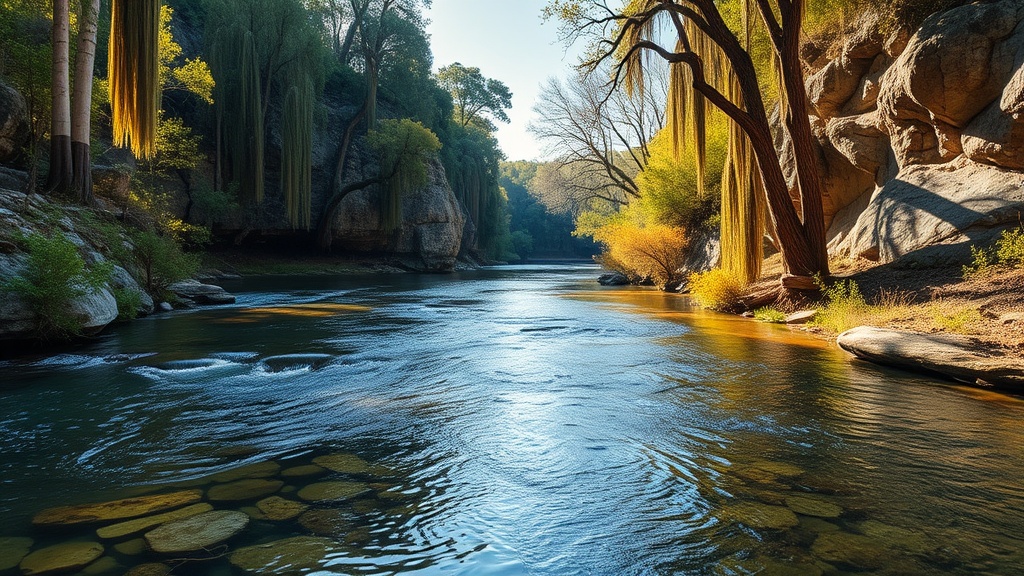
The last time I stood in the Frio River was a Thursday morning in mid-October 2024. The water was shin deep at the crossing near Garner State Park, cold enough to make me catch my breath, and the cypress trees along the bank had just started turning. I counted four other people within eyeshot. The limestone bluffs caught the early light in a way that made the whole canyon feel like it belonged to a different state entirely. That version of the Frio is real, and it is spectacular. But it shares a zip code with a version that involves bumper-to-bumper traffic on FM 1050, a parking lot at Garner that fills before 9 a.m., and river access points so packed with inflatable flamingos that you can’t see the water beneath them. Both versions are the Frio. The one you get depends entirely on your timing.
Here’s the crowding breakdown, stripped of any romanticism. From Memorial Day through Labor Day, Saturday at the Frio is not a weekend getaway; it’s a music festival without the music. Garner State Park moved to a reservation system for day use during peak season, and those slots fill weeks in advance. If you show up on a July Saturday without a reservation, you will be turned away at the gate. That’s not a soft warning. Rangers will physically close the entrance. The river access points outside the park, the ones locals call the “low water crossings,” get hammered just as hard because everyone turned away from Garner migrates to them. Neal’s Lodges, the old school cabins along the river, books out months ahead for summer weekends. The entire corridor between Concan and Leakey operates at a capacity it was never designed for from June through August on Fridays and Saturdays.
Thursdays and Sundays in summer are noticeably better. Not empty, but manageable. You can get a Garner day-use reservation for a Thursday in July if you book it two to three weeks out. The real shift, though, is shoulder season. Late September through mid-November and again from mid-March through April, the Frio area becomes a fundamentally different place. Weekday visits during those windows require zero advance planning for river access. Weekend visits need maybe a week’s notice for Garner reservations. The water is colder, yes, but the river still runs, the hiking at Garner is arguably better without the heat, and the canyon’s acoustics do something extraordinary when there aren’t a couple hundred people shouting over each other.
Which brings us to the lodging problem, and this is the part that makes or breaks a Frio trip for anyone reading this article. The dominant accommodation model in the Concan area is the large rental compound: a main house with multiple outbuildings sleeping a dozen or several dozen people, marketed to family reunions and bachelor parties. These properties cluster along the river, and the ones closest to popular access points become their own noise generators. You drive two hours to escape Austin’s crowd energy, check into your cabin, and discover that the property next door has a DJ and a keg. I’ve heard this story from friends enough times to consider it a structural feature of the area, not an anomaly.
Smaller, more intentional lodging options do exist, and they’re worth seeking out specifically because the default experience skews so heavily toward large-group chaos. Camp Hideaway is one I’d flag in this context: a property in the Concan area built around a quieter, more deliberate experience rather than the “pack in as many guests as possible” model that dominates the corridor. If your entire reason for driving two hours is to not recreate the Austin crowd dynamic, where you sleep matters as much as when you visit.
On booking lead times specifically: for summer weekends (June, July, August, Friday and Saturday nights), you need to book lodging six weeks out minimum, and eight to ten weeks is safer for the better properties. Garner day-use reservations for those same dates should be grabbed four weeks ahead. For shoulder season weekends, two to three weeks of lead time is plenty. For weekday visits from October through February, you can genuinely book a week before or even last minute for many properties. The Frio area has a binary demand curve, not a gradient. It’s either slammed or it’s wide open, with very little in between.
So the honest verdict on whether two hours of driving is worth it: the Frio earns the extra distance if you can visit on a weekday, or during shoulder season, or both. It earns it if you’ve secured lodging that matches your expectations for quiet. It earns it if you’re the kind of person who finds a spring-fed river running through a limestone canyon to be a fundamentally different experience than a lake or a pool. And it does not earn it if your only option is a Saturday in July, your lodging is a last-minute booking at a large compound property, and your tolerance for crowds is low. Under those conditions, you’ll spend four hours round trip in the car to experience something louder and more congested than Barton Springs on a Sunday. The Frio’s reward ceiling is the highest of any destination in this guide. Its floor is also the lowest. The gap between those two outcomes is entirely a function of planning.
Destinations Sofia Is Actively Steering You Away From Right Now
The positive verdicts above mean something precisely because these exist. Here’s what I can’t recommend right now, and why.
Hamilton Pool Preserve. The timed entry reservation system was supposed to fix the overcrowding problem. It didn’t fix it. It moved it. You now have a reservation system that fills up weeks in advance, a parking situation that still bottlenecks at the trailhead, and a swimming prohibition that’s been in effect more often than not due to bacteria levels in the water. On the rare weekends when swimming is allowed and you’ve secured a reservation, the grotto is genuinely spectacular. But I can’t recommend a destination where the most likely outcome is standing in a line you reserved the right to stand in, staring at water you can’t enter. If you’re determined: go on a weekday in late October or early November, check the Travis County website the morning of for water quality status, and treat swimming as a bonus rather than the point. Under any other conditions, skip it.
Wimberley. This one stings to write. Two years ago, I recommended Wimberley without hesitation. What’s happened since is a textbook case of social media saturation accelerating commercial turnover. Several of the independent shops have been replaced by Instagram bait storefronts selling mass-produced goods at “artisan” prices. Blue Hole’s reservation system is now as competitive as Hamilton Pool’s. The weekend traffic on Ranch Road 12 has become punishing enough that the drive itself erodes whatever relaxation you were seeking. Wimberley still has bones worth admiring, but the current version of a Wimberley weekend is a downgraded experience at an upgraded price. I’ll revisit this assessment if the trend reverses. Right now, it hasn’t.
What to watch for everywhere else. The early warning signs are consistent: a spike in “hidden gem” TikTok posts (the phrase itself is the canary), new shuttle or tour bus services appearing where none existed, local restaurants quietly raising prices while cutting portion sizes, and reservation systems being introduced for places that previously operated on a first come, first served basis. That last one matters most. A reservation system isn’t a sign that a destination is well managed. It’s a sign that demand has already outstripped the experience’s capacity to absorb it. If a place I’m currently recommending in this guide adds a reservation system in the next six months, reassess before you go.
The Timing Grid: When Each Destination Is Actually Worth It vs. When to Stay Home
The destination choice is only half the decision. The timing question is where most recommendations fail completely. A perfect weekend getaway from Austin turns miserable if you show up during the wrong week, and a supposedly “overrated” spot can feel like a private discovery if you time it right. Here’s the month-by-month and day-by-day breakdown built from years of actual trips, not from tourism board press releases.
| Destination | Best Window | Worst Window | Holiday Weekends | Day-of-Week Edge | Status |
|---|---|---|---|---|---|
| Fredericksburg | Jan, Feb; Tue, Thu shoulder season | Oct weekends 3, 4; Memorial Day; Labor Day | Avoid Memorial Day & Labor Day entirely | Tue, Thu transforms the experience | WATCH |
| Wimberley | First 2 weeks of November; Jan, Feb | March, May; October; any summer Saturday | Survivable only with private river access | Weekday-only recommendation | AVOID (peak) |
| Frio / Concan | First 2 weeks of November; late September | July 4th weekend; any June, Aug Sat | July 4th is among the worst calls in this guide | Thursday arrival changes everything | WATCH |
| Bastrop / Lost Pines | Year-round; spring and fall ideal | No hard avoid; just book cabins ahead | Manageable compared to Hill Country | Flexible; even Saturdays are calm | HOLD |
| Johnson City / Pedernales | Spring and fall; midweek for solo hikers | Spring break weekends; fall festival season | Better than Fredericksburg; still book ahead | Saturday Wolf Mtn Trail = solitude | HOLD |
| Llano / Mason | Now. Window is open. | No hard avoid yet; monitor for discovery signals | Quieter than any Hill Country alternative | Flexible; town still runs on a slow clock | HOLD |
| Marfa | January; Labor Day weekend (surprisingly good) | October and March; infrastructure can’t absorb peak | Labor Day works; most others don’t | Midweek in any month is best | WATCH |
| Hamilton Pool | Weekday, late Oct, Nov, water quality permitting | Any weekend, any season | Do not attempt | Weekday-only; verify swim status morning-of | AVOID |
Fredericksburg: January through February is genuine off season; tasting rooms are quiet, lodging drops significantly, and Main Street feels like an actual town. March starts the climb. April through May is full peak thanks to wildflower season and pleasant weather. June through August is hot but still busy with families. September offers a brief shoulder window. October is the month most people get wrong: the first two weekends are manageable because leaf color hasn’t peaked, but weekends three and four are gridlock on 290. November before Thanksgiving is solid. December brings the Christmas market crowds. Verdict on holiday weekends: Memorial Day and Labor Day are both unbearable. Skip them entirely.
Wimberley: Peak runs March through May and again in October. The genuine sweet spot is the first two weeks of November, when temperatures cool but the Blanco River still has water and the weekend market vendors are winding down. Summer is brutally hot but the swimming holes pull crowds anyway, especially on Saturdays. January and February are quiet to the point of emptiness; some shops close midweek. Holiday weekends here are survivable only if you have a private property with river access. Otherwise, Blue Hole and Jacob’s Well become lines, not experiences.
Frio River area (Concan, Garner State Park): The clearest best window in this guide is the first two weeks of November: river levels are typically still decent, daytime highs sit in the 70s, and summer camp season is long over. Summer, especially June and July, is pure chaos at Garner State Park. Fourth of July on the Frio is one of the worst timing decisions you can make for any weekend getaway from Austin. The tubing outfitters are at capacity, the river gets trashed, and the drive back on US 83 is punishing. February and March are underrated if you’re there for hiking rather than swimming.
Marfa: October and March are peak. The crowds are smaller in absolute numbers than Fredericksburg, but Marfa’s infrastructure is so limited that even moderate demand creates problems: fully booked hotels, long waits at the three restaurants everyone wants. January is genuinely cold and wind whips across the plateau, but that’s precisely when the town feels most like itself. August is off season for good reason; the heat at that elevation surprises people. Labor Day weekend in Marfa is actually one of the few holiday weekends that works because most Texas travelers head to water, not desert.
The day-of-week delta matters everywhere. A Thursday arrival changes the entire experience at any of these destinations. Friday afternoon arrivals put you in the same traffic pulse as every other Austinite heading out on I-35 or 290. Saturday day trippers are the real crowd driver at Fredericksburg and Wimberley; they arrive by 11 a.m. and leave by 6 p.m. If you’re already settled in by Thursday evening, Saturday’s surge becomes background noise rather than your whole trip. Sunday departures before 10 a.m. dodge return traffic almost completely. The single highest-impact scheduling decision for any weekend getaway from Austin isn’t the destination or the month. It’s leaving Thursday instead of Friday.
Before You Book: The Logistics Reality Check Every Austin Weekend Deserves
You’ve picked your destination. You can already picture the porch, the river, the quiet. Now comes the part that separates a great weekend from one that starts with a two-hour argument in the car: the logistics. Weekend getaways from Austin live or die on practical details that most travel guides skip entirely.
Drive time reality: when you leave changes everything. A Friday 4 p.m. departure from central Austin to Fredericksburg takes roughly 90 minutes. Leave at 6 p.m., and that same drive balloons past two hours as I-35 south and US-290 west stack up. For closer destinations like Wimberley or Dripping Springs, the gap is smaller but still noticeable: 45 minutes at 4 p.m. versus over an hour at 6 p.m. Farther destinations feel the squeeze most. A 4 p.m. Friday run to Garner State Park clocks around three and a half hours; at 6 p.m., you’re looking at four-plus, arriving after dark. The tier breakdown is simple. Under 90 minutes (Wimberley, Dripping Springs, Bastrop): flexible departure. Two to three hours (Fredericksburg, New Braunfels, Canyon Lake): leave by 4 p.m. or accept the penalty. Three hours-plus (Garner, Port Aransas, Lost Maples): leave Thursday evening or very early Friday.
Budget tiers by destination area. Camping runs roughly $20 to $40 per night at state parks across all destination bands, though Texas Parks and Wildlife reservation fees add a few dollars. Mid-range cabins and vacation rentals cluster between $150 and $250 per night for Hill Country spots like Fredericksburg and Wimberley; expect $100 to $175 closer to Bastrop or Canyon Lake. Splurge properties with pools, views, or boutique hotel polish range from $300 to $500 per night in Fredericksburg and $250 to $400 in New Braunfels. Gas round trip from central Austin: budget about $25 to $35 for closer destinations, $50 to $70 for the three-hours-plus tier, based on current fuel prices and a vehicle averaging 25 mpg.
Booking lead times that actually matter. Fredericksburg on a spring or fall weekend requires reservations four to six weeks out for anything desirable. Garner State Park cabins during summer sell out the moment the reservation window opens, which is five months in advance. Wimberley and Canyon Lake rentals are more forgiving; two to three weeks typically works outside of holiday weekends. For genuine last-minute trips, Hipcamp surfaces private land camping options that don’t appear on mainstream platforms, and checking vacation rental sites on Wednesday for that same weekend often reveals cancellation inventory in Bastrop and New Braunfels.
Match the destination to your group, not the other way around. Couples seeking quiet should prioritize the Frio Canyon area on a shoulder-season weekday, or a Wimberley creekside cabin in January. Both reward stillness when the timing is right. Families with young kids do best at Canyon Lake or New Braunfels, where shallow water access and short drive times reduce meltdown risk. Solo travelers and small friend groups get the most from Fredericksburg’s walkable food and wine scene during a midweek shoulder trip, or Bastrop’s trail network, where the social infrastructure matches the energy. The same destination that scores perfectly for a couple can frustrate a family, and vice versa. Pick for the group you actually have, not the one in the photos.